Monday, 27 July 2015

Coastal Zone (4)


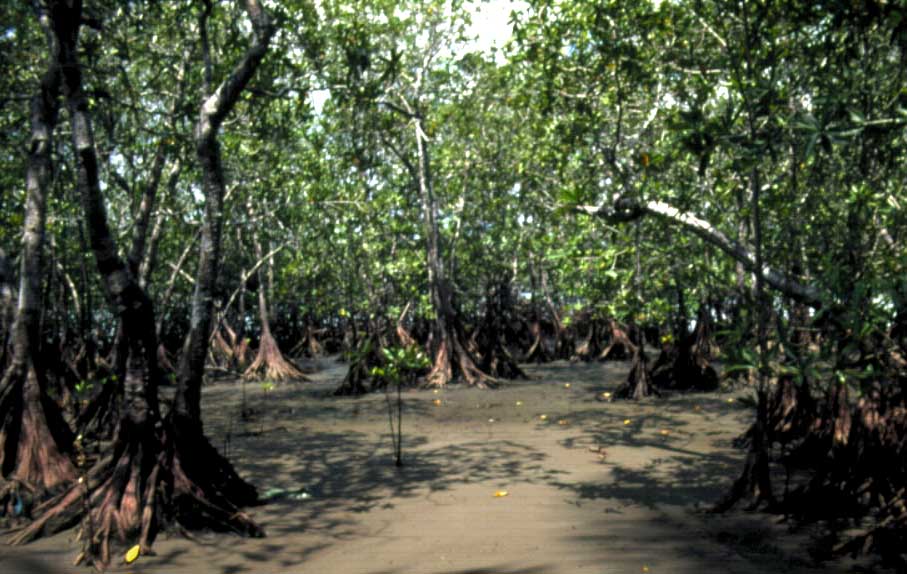
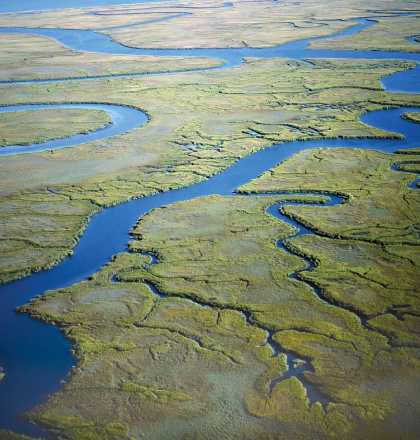
The coastal zone can be divided into several areas, Estuaries, Coastal Wetlands and Mangrove Swamps;  Rocky and Sandy Shores and Coral Reef.


Coastal Wetlands

Mangrove Swamps
Rocky and Sandy Shores
Coral Reef
Estuaries

Bathypelagic Zone (7)

The bathyal zone or bathypelagic  (also known as midnight zone) is the part of the pelagic zone that extends from a depth of 1000 to 4000 metres (3300 to 13000 feet) below the ocean surface. It lies between the mesopelagic above, and the abyssopelagic below. The average temperature hovers at about 4 °C (39 °F).
Animals of the Bathypelagic Zone
·         rely on detritus for food or on eating other animals in this zone.
·         not threatened by predators that can see them,
·         do not have powerful muscles.
·         need to have the right adaptations to survive in this lethal area.


 At this depth and pressure, the animals most commonly found are fish, mollusks, crustaceans, and jellyfish.
 In the bathyal some of the world's largest whales feed. Sperm whales will hunt at these depths on occasion to prey on giant squid.
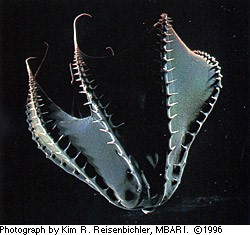
Black and red are the predominant colours of animals here and any bioluminescence is usually blue since red is not visible at these depths. The most common mollusk in the bathypelagic zone is the vampire squid, an animal that can turn itself inside-out to use its spiky tentacles to deter predators or capture prey. Many forms of nekton live in the bathyal zone, such as squid, large whales, and octopuses. Sponges, brachiopods, sea stars, and echinoids are also common in the bathyal zone.

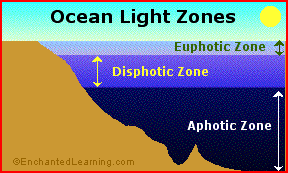
Due to the lack of light

  •  Sunlight does not reach this zone( no primary production) and difficult for fish to survive.
  •  some species do not have eyes, however those possessing eyes in this zone include the viperfish and the frill shark.
The fish in this zone:

  • ·        energy efficient( hard to find nutrients)
  • ·        slow metabolic rates to conserve energy
  • ·        weak muscles
  • ·        soft skin
  • ·        slimy bodies
  • ·        small eyes
  • ·        transparent skin
Picture above:The tentacles are often thrown over prey like a net from above.
 The snake dragonfish resembles the viperfish or dragonfish of the mesopelagic zone and also comes up to hunt at night but has to travel further as it lives in deeper water than the others.


bioluminescence in abyssal zoneThe anglerfish of the bathypelagic zone is well known for its enormous mouth and a lure that resembles a flashlight on its head. Not only does the angler fish have huge long teeth on the jaws, it is also equipped with teeth in its throat! Males of this species are found in the form of a tiny parasitic fish carried by the female near her genitals. Both sexes can be found anywhere from the surface to the deepest waters.
Amphipods are crustaceans and scavengers in the bathypelagic zone that hide using a transparent red body. Other crustaceans found in the bathypelagic zone include shrimp.
Echinoderms seem to do well in deep ocean water, although they are not usually found in the open ocean. They survive by scouting out detritus on the ocean floor or by swimming through the water hunting for floating food.


Slime stars are in the echinoderm family and can reach up to 21 cm in length—large for an echinoderm.

What are the environmental factors? (3)


Water

Water is the essential of every living things. It is no surprise that even marine life in the Oceanic Zone need them. They are the medium of our life, one that allowed us to live. It helped us transfer heat energy from the equatorial region pole ward into both hemispheres and dissolve many compounds including nutrients from nitrates to dissolved oxygen, carbon and silicates. 


Light

Likewise with water, light is vital to many. Every marine foods chains begin with photosynthesis from single-celled organisms  such as the phytoplankters whose life varies from daily light and seasonal changes in the intensity of life and duration.  Photosynthesis is there to maintain life and help in their growth and reproduction. Without them, life will void in due time.

Temperature

Temperatures go from high to low the deeper we ventured down the zone. However, no matter how cold it get, they won't go freezing because of the  
Salt water
 which act as an anti-freeze mechanism. They very cold one  rise to the surface and form  
Ice


Oxygen
The very essence of life required by every living things, oxygen. In the ocean, dissolved oxygen is formed by sea water coming in contact with the atmosphere and as a byproduct of photosynthesis. Oxygen in sea worked differently than on land as it varied from temperature and salinity. The more they increased, the more the amount of dissolved oxygen decreases.


Salinity
The saltines varies across the world oceans but most sea water are around 3% to 4%. Though there are area that go nearly as high as 40%. However, rest assured as marine life are adapted to keep their body salts at a constant level, so that they don’t interfere with the metabolism within cells. Still significant changes in salinity can cause problems for some or
                                                                 even 


Euphotic Zone (6)


There are different zones in the sea and i will be talking about the layer of sea water that receives enough sunlight for photosynthesis for plants and phytoplankton to occur.

Like plants, phytoplankton uses carbon dioxide and releases oxygen to convert minerals to a form food source for sea organisms to feed on. 

This layer is also known as Euphotic Zone/Sunlit Zone.

In this zone, there is enough light for photosynthesis. Which means many plants and photosynthetic organisms live here and food is abundant. About 90% of all marine life live in this zone due to high amounts of food.

There is high dissolved oxygen and low dissolved oxygen in this zone. This is because of the high amounts of sunlight which causes the plants to photosynthesize causing high levels of dissolved oxygen. This is another reason why marine life live in this zone. 

This is important because if the sunlight is too low and the rate of respiration is faster than the rate of photosynthesis, the phytoplankton cannot survive (primary producers which uses sunlight as a source of food). 


Examples of Marine Life living in the Euphotic Zone


  • Angelfish are brightly-colored, flattened fish that live in shallow warm waters.


  • Pufferfish are a type of poisonous fish that can swallow water to double its size.

How do some of the animals camouflage from its predators?
  • Some of the animals in the Euphotic Zone have countershading.
  • It is when an animal is light on its underside and dark on its upper parts. 
  • When a predator looks down at a countershaded animal, it blends into the darker waters
  • When a predator looks at a countershaded animal from below, the light underbelly disappears into the light. 
  • This adaptation helps camouflage the organism, hiding it from predators and allowing it to sneak up on prey. 
  • Most sharks, for example, are countershaded.
  • To ensure that there is minimal silhouette is cast.


Depth Of The Zones (2)

Depth of the zones
Euphotic Zone: 200m
high temperature, low nutrients

Mesopelagic zone: 300-1000m
No plants exist in this zone due to lack of light.
Bathypelagic Zone: 700-1000m 
Low dissolved oxygen & low nutrients
Abyssopelagic  Zone: 2000-4000m
Temperatures around 2 °C to 3 °C,   Very dark
Hadalpelagic & Benthic zone: 6000-10000m
Oceanic trenches, pressure in the hadal zone exceeds 1,100 standard atmospheres (110 MPa; 16,000 psi) and temperature of water is slightly above freezing.

Oceanic Zones (1)

OCEANIC ZONES:
zonesA: Coastal Zone
B: Pelagic Zone
C: Euphotic Zone
D: Bathyal Zone
E: Abyssal Zone
F:  Benthic Zone